Skip to content
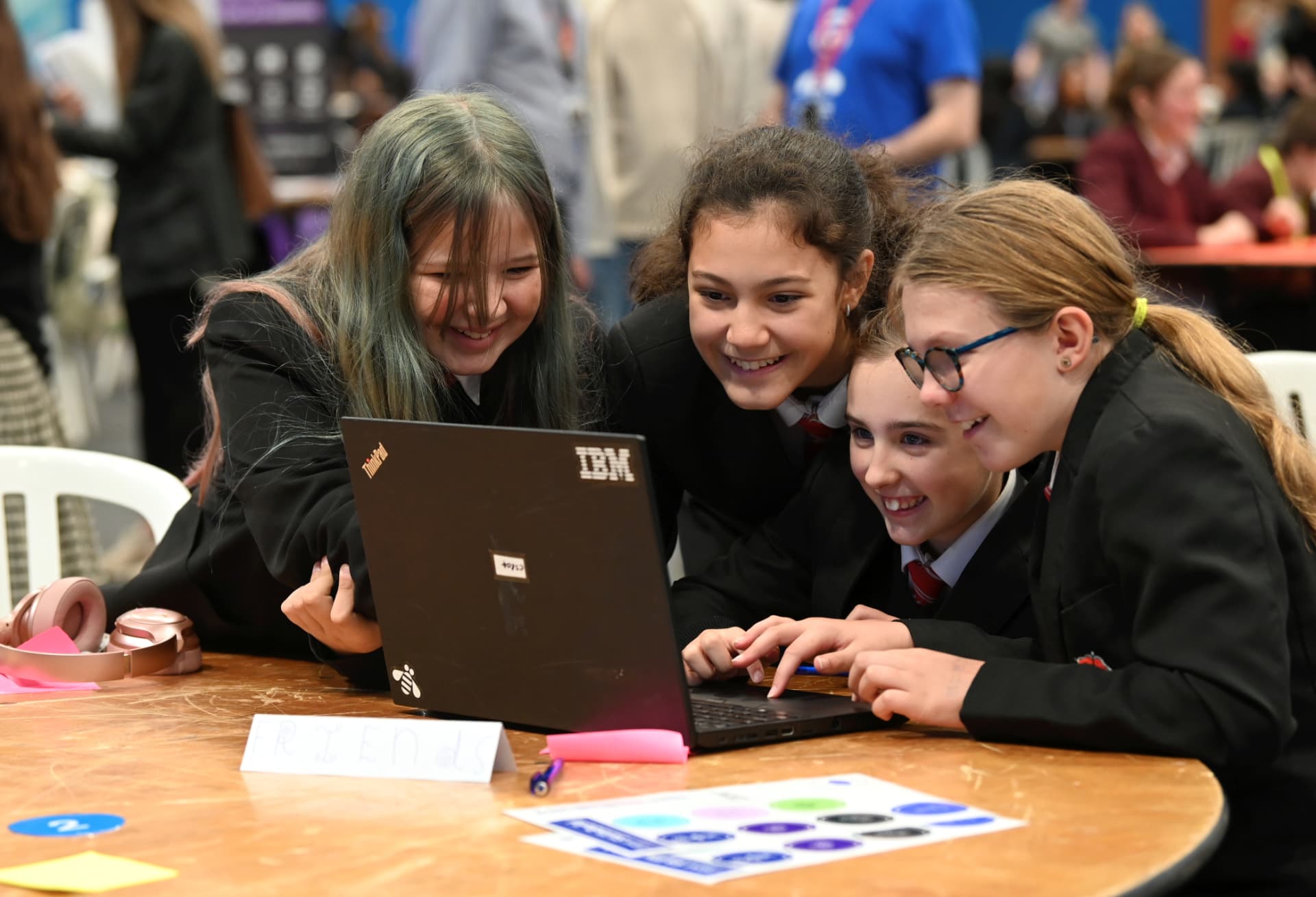
Four students gathered around a laptop

There’s a place in tech with your name on it

Good at maths? Love design? Obsessed with puzzles? Tech needs you and your interests.

What is TechFirst?

A national programme that gets young people in the South West together with the people working with the technology of the future.

  • Free to join

    Workshops, competitions, clubs and online sessions, all free for schools and students across the South West.

  • Led by people who do it

    Sessions run by people working in tech: engineers, cyber analysts, researchers and founders.

  • Hands-on, not lectures

    You get to try things: build, hack, test and compete, rather than sit and listen.

  • No experience needed

    You don't have to be good at coding or know anything yet. Being curious is enough.

The tech that’s shaping your world

These are the six areas of tech the programme gets stuck into. Tap one to see what it actually is.

Artificial Intelligence

Computers that can understand language, create text and images, and work out how to reach a goal on their own.

Take a closer look

AI means teaching computers to do things that normally need human thinking, like understanding language, creating text and images, and making decisions. AI doesn’t just follow a fixed set of instructions. It learns by finding patterns in huge amounts of data. The newest systems, known as agentic AI, go further. Give them a goal and they can work out the steps and use other apps and tools to get it done, from researching a topic to writing and testing code. AI is already helping doctors spot diseases earlier and helping scientists make discoveries faster. The big challenge now is making it smarter, fairer and safer, and that takes people with all kinds of skills, not just coders.

Cyber Security

Protecting computers, networks and people from hackers, scams and online attacks.

Take a closer look

Every message you send, game you play and payment you make depends on keeping data safe. Cyber security is about protecting computers, networks and people from hackers, scams and online attacks. It’s part detective work and part puzzle-solving. You find the weak spots before criminals do, track attacks back to where they came from, and build systems that are hard to break into. Hospitals, banks and even power stations now run online, so cyber defenders are needed more than ever.

Quantum Technologies

At the very smallest scale, the world follows strange rules and we can use them to do things ordinary technology can’t.

Take a closer look

At the very smallest scale, among atoms and particles of light, the world follows strange rules. Particles can be in more than one state at once, and two particles can stay linked even when they’re far apart. Quantum technologies use these rules to do things ordinary technology can’t. Quantum computers could one day solve problems too complex for today’s supercomputers, like designing new medicines and materials. Quantum sensors can pick up tiny changes in gravity and magnetism, which could help with navigation without GPS or new kinds of brain scans. The field is still young, so the people who join now could shape what it becomes.

Semiconductors

Special materials switched between letting electricity through and blocking it.

Take a closer look

Semiconductors are special materials, usually silicon, that can be switched between letting electricity through and blocking it. That simple trick is what makes microchips work. The chip in your phone holds billions of tiny switches, each thousands of times thinner than a human hair. Chips power almost everything: phones, cars, games consoles, medical equipment and satellites. Designing and making them is some of the most precise engineering on the planet.

Engineering Biology

What if you could program living things the way you program a computer?

Take a closer look

What if you could program living things the way you program a computer? Engineering biology uses engineering tools to design and build with DNA, cells and microbes. Scientists already use it to make medicines like insulin and to grow crops that can survive drought. They’re also making packaging from mushrooms and creating enzymes that break down plastic. It could help solve some of the world’s biggest problems, from disease to climate change.

Advanced Telecommunications

The technology that moves information around the world and the next generation of faster, more reliable networks like 5G and 6G.

Take a closer look

Telecoms (short for telecommunications) is the technology that moves information around the world through mobile networks, fibre-optic cables, Wi-Fi and satellites. Advanced telecoms is the next generation: faster, more reliable networks like 5G and future 6G. These could connect driverless cars and smart cities, and let doctors guide surgical robots from miles away. It’s also about bringing fast internet to remote places so nobody gets left behind.

Jobs that don’t exist yet

Technology moves fast. Most of the tech jobs people do today didn’t exist when you were born and the biggest ones are still being invented.

  • New jobs keep appearing

    Every new technology brings roles with it: the people who train AI, keep it honest, design the chips and decide what it should be used for.

  • You don't have to pick yet

    Nobody expects you to know what you want to be. Trying a few things now is the head start.

  • What you're good at counts

    Fixing things, telling stories, arguing fairly, understanding people. Tech needs all of it.

Things you could do

All of these are free. Ask your teacher if your school can take part.

Hands-on days

Days out where you get to try tech for yourself.

Empower

Years 7 to 9
Once a year, Gloucestershire

A free day out where you try hands-on tech activities with real companies. There are girls-only, SEND and mixed sessions.

Horizons

Years 7 to 11
Once a year, across the South West

A free day of hands-on activities with tech companies. It helps you think about what to choose next and where tech could take you.

Meet people in tech

Talk to people who work in tech, try work experience and ask your questions.

Checkpoint

Students who attended Empower or Horizons
A few online sessions a year

Online catch-ups after Empower or Horizons, with talks and chats with people in tech.

Ignite

Years 10 to 13
One week a year, across the South West

A week of work experience where you visit a different tech company each day.

Tech Lectures

Years 12 and 13
Once a year, across the South West

A free lecture for sixth formers about a big new idea in tech, explained by experts.

Launchpad

Years 10 to 13
Three webinars, winter and spring

Online talks where students and apprentices just a few years older than you share how they made their choices. Bring your questions.

Switchboard

Schools, colleges and employers
Available all year

Your teacher can use it to find work experience, trips and visits with tech companies.

I’m a Computer Scientist

Students aged 8 to 18
Available all year

Ask your questions to up to 40 real people working in tech, through a question-and-answer website your teacher uses in class. It is all typed and moderated — no cameras. Read their profiles, ask follow-ups, then vote for your favourite to win a £500 prize.

Founders’ Forge SW

Years 10 to 13, small groups
Available all year

Got an idea for your own product? Get one-to-one help from people who have started their own companies.

Ask your teacher or careers advisor

Find out if your school or college is already part of TechFirst. If it is, they’ll know what’s coming up and how you can get in.

Look at what’s on

Upcoming workshops, competitions and events across the South West, plus online sessions you can join from anywhere.